


Expedition in Nepal
- Mt. Everest Expedition 62 Night 63 Days
- Mt. Manaslu Expedition 53 Night 54 Days
- Mt. Cho oyu Expedition 45 Night 46 Days
- Mt. Baruntse Peak Expedition 39 Night 40 Days

Mt Everest Expedition (8848m)
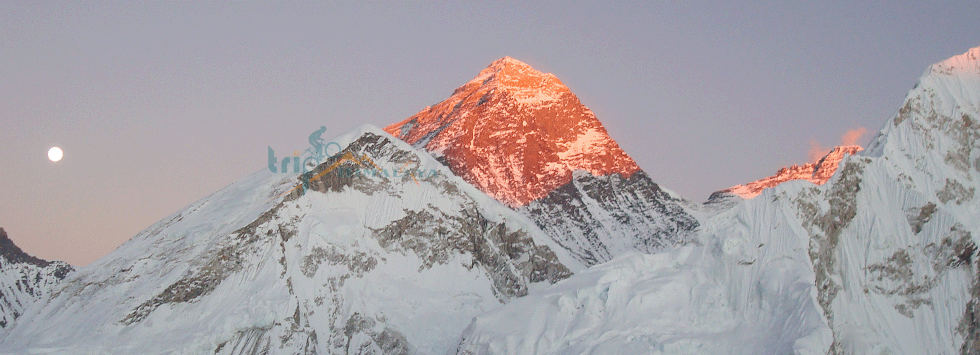
Mount Everest is the Earth's highest mountain, with a peak at 8,848 metres (29,029 ft) above sea level. It is located in the Mahalangur section of the Himalayas. The international border between China and Nepal runs across the precise summit point.
The Everest Expedition First successful ascent by Mt. Everest New Zealander Edmund Hillary and Tenzing Norgay, a Nepali. They reached the summit at 11:30 am local time on 29 May 1953 via the South Col Route.
The ascent via the southeast ridge begins with a trek to Base Camp at 5,380 m (17,700 ft) on the south side of Everest in Nepal. Expeditions usually fly into Lukla (2,860 m) from Kathmandu and pass through Namche Bazaar. Climbers then hike to Base Camp, which usually takes six to eight days, allowing for proper altitude acclimatization in order to prevent altitude sickness. Climbing equipment and supplies are carried by yaks, dzopkyos and human porters to Base Camp on the Khumbu Glacier.
The Everest Climbers will spend a couple of weeks in Base Camp, acclimatizing to the altitude. During that time, Sherpas and some expedition climbers will set up ropes and ladders in the treacherous Khumbu Icefall. Seracs, crevasses and shifting blocks of ice make the icefall one of the most dangerous sections of the route.
From Everest Camp I, climbers make their way up the Western Cwm to the base of the Lhotse face, where Camp II or Advanced Base Camp (ABC) is established at 6,500 m (21,300 ft). The Western Cwm is a flat, gently rising glacial valley, marked by huge lateral crevasses in the centre, which prevent direct access to the upper reaches of the Cwm. Climbers are forced to cross on the far right near the base of Nuptse to a small passageway known as the "Nuptse corner". The Western Cwm is also called the "Valley of Silence" as the topography of the area generally cuts off wind from the climbing route. The high altitude and a clear, windless day can make the Western Cwm unbearably hot for climbers.
From Everest Base Camp, climbers ascend the Lhotse face on fixed ropes up to Camp III, located on a small ledge at 7,470 m (24,500 ft). From there, it is another 500 meters to Camp IV on the South Col at 7,920 m (26,000 ft). From Camp III to Camp IV, climbers are faced with two additional challenges: The Geneva Spur and The Yellow Band.
On the South Col, climbers enter the death zone. Climbers typically only have a maximum of two or three days that they can endure at this altitude for making summit bids. Clear weather and low winds are critical factors in deciding whether to make a Everest summit attempt. If weather does not cooperate within these short few days, climbers are forced to descend, many all the way back down to Base Camp.
Mt Everest Expedition 2013 Nepal.
S.No |
Date |
Itinerary from |
To |
Accommodations |
Activities |
01 |
04 April 2014 |
Kathmandu |
Arrival |
Hotel |
00 |
02 |
05 April 2014 |
Kathmandu |
perper permint |
Hotel |
00 |
03 |
06April 2014 |
Kathmandu |
wel come dinner |
Hotel |
00 |
04 |
07 April 2014 |
Kathmandu |
Lukla Pakkding (2600m) |
Tea House |
Trek |
05 |
08 April 2014 |
Phakding |
Namche Bazar (3446m) |
Tea House |
Trek |
06 |
09 April 2014 |
acclimatization |
acclimatization |
Tea House |
Rest |
07 |
10 April 2014 |
Namche Bazar |
Tengboche (3800m) |
Tea House |
Trek |
08 |
11 April 2014 |
Tengboche |
Pheruche (4200m) |
Tea House |
Trek |
09 |
12 April 2014 |
Pheruche |
Lobuche |
Tea House |
Trek |
10 |
12 April 2014 |
Acclimatization |
Acclimatization |
Tea House |
Rest |
11 |
13 April 2014 |
Lobuche |
Everest Base Camp |
Camp |
Trek |
12 to 55 |
14 April 2014 |
24 May 2014 |
Climbing Period on Mt. Everest. |
Camp |
climb |
56 |
25 May 2014 |
Base Camp |
Base Camp Clean Up. |
Camp |
Trek |
57 |
26 May 2014 |
Base Camp |
Pheruche |
Tea House |
Trek |
58 |
27 May 2014 |
Pheruche |
Namche Bazar |
Tea House |
Trek |
59 |
28 May 2014 |
Namche |
Lukla |
Tea House |
Trek |
60 |
29 May 2014 |
Lukla |
Kathmandu |
Hotel |
flight |
61 |
30 May 2014 |
Kathmandu |
shopping/Rest |
Hotel |
00 |
62 |
31 May 2014 |
Kathmandu |
00 |
Hotel |
00 |
63 |
01 June 2014 |
Kathmandu |
Flight Back |
Home |
Flight |
Cost Includes
• Arrival Departure in international Airport and fair wel come dinner.
• 6 night’s hotel accommodation in a 3 star hotel in Kathmandu on BB plan.
• Sagarmatha National Park fee.
• Everest climbing permit.
• Round trip flight Kathmandu-Lukla-Kathmandu.
• Round trip flight Kathmandu-Lukla-Kathmandu Liaison Officer.
• Round trip flight Kathmandu-Lukla-Kathmandu for guide and staffs.
• Cargo to Lukla and Transportation of food supply to Base Camp.
• Necessary porters, yaks from Lukla to base camp & lukla.
• Tea House accommodation, three times meal during the trekking.
• High altitude tents (North Face) for all members.
• Base Camp single tent for climbing Sherpa, BC staff and Liaison Officer.
• All kitchen tent, stores tent, dining tents, toilet tents, tables and chairs, and cooking utensils for Base Camp.
• Gas heating in the dining hall.
• All food and fuel for Base Camp and higher camps during expedition.
• Services of cook and kitchen boy at Base Camp and cook at Camp two.
• One high altitude Sherpa per climber to carry all food and gear to higher camps.
• 5 oxygen bottles (4 lts) per member with mask and regulator (for use only).
• 3 oxygen bottles (4 lts) per climbing Sherpa with mask and regulator
• Common climbing equipment (necessary rope, ice bars, ice screws, etc)
• Res top toilet bags to bring human waste of the mountain for all members.
• Parabolic Solar Cookers at Base Camp and Camp two.
• Sat Phone available at Base camp, but nominal charge for use.
• Walkie-talkies for each member base unit at Base Camp.
• Khumbu Ice Fall fixed route.
• Solar panel at Base Camp for light.
• Insurance for Climbing Sherpas, Cooks, Liaison Officer, and local porters.
• Equipment allowances and wages for Climbing Sherpa, Sirdar, officer, cooks, kitchen boys.
• Government Liaison Officer & round trip flight.
• Garbage deposit.
Cost Excludes
• Lunch and dinner in Kathmandu.
• Hotel after 6 nights stay in Kathmandu.
• Personal climbing gear above base camp.
• Personal travel, accident, medical, emergency evacuation, and lost luggage.
• Applicable permit fees and customs charges, etc. for SAT phone, communication equipment, and commercial filming.
• Expenses of a personal nature such as hard and soft drinks, laundry, postage, telephone, Email, etc.
• Applicable customs duty and import license fees for all personal expedition goods arriving in Nepal by air/road as cargo
• Climbing Bonus up to South Col: US$ 1500 per Climbing Sherpa.
• Climbing Bonus above South Col: US$ 500 per Climbing Sherpa.
• If you need more than 5 oxygen bottles USD 400.
• Tips and bonuses.


