


Tour Package
- Kathmandu Valley Tour23 Night 24 Days
- Ktm - Lumbini to Pokhara Tour23 Night 24 Days
- Kathmandu Lhasa Tour18 Night 19 Days
- Lhasa Kathmandu Tour20 Night 21 Days
- India Tour20 Night 21 Days
- Bhutan Tour20 Night 21 Days
Kathmandu Valley Tour
Nepal is constitutionally a Hindu kingdom so non- Hindus cannot enter the temple, although Buddhists can. But no one is allowed to enter the inner sanctum except the Bhattas, the main priests who come from the south of India. The temple starts swarming with devotees around 4am every morning.
However the top of the hill to the east of the temple is the ideal place for the non Hindu visitor to view the temple, its rich surroundings, and below on the edge of the Bagmati river the ghats where the dead are brought to be cremated Situated on the top of a small hill about 15 kilometers east of Kathmandu and only a few miles north of Bhaktapur, the temple of Changu Narayan is perhaps the best and oldest in the context of Nepa- lese art and architecture. Built around 239 A.D., it s not only the temple but the whole complex which is an open air museum - breathtaking and bewildering in character.
Kathmandu Valley Tour
Day 01 : Arrival and transfer to your hotel. Welcome dinner.
Day 02: Pashupatinath and Baudhanath
Pashupatinath is one of the four most important religious sites in Asia for Shiva devotees. Pashupatinath, dedicated to Shiva the Destroyer, is the holiest Hindu pilgrimage destination in Nepal. Although the Pashupatinath Temple was only built in the fifth century and later renovated by Malla kings, the holy site is said to have existed from the beginning of the millennium.
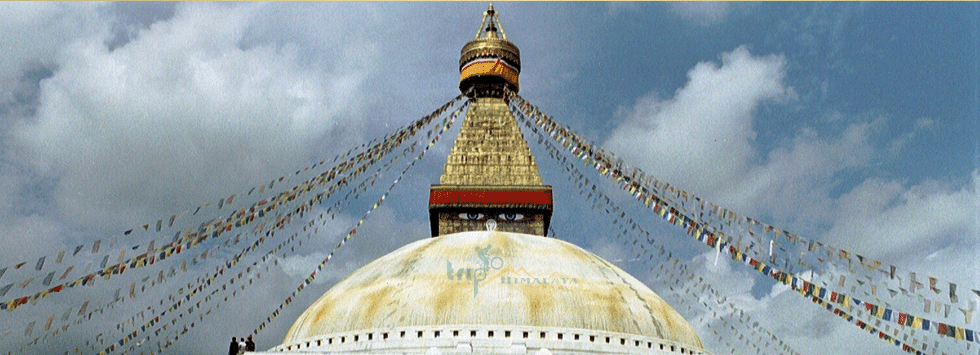
Bouddhanath is the center of Tibetan culture in Nepal. The 36-meter-high stupa of Bouddhanath is one of the largest stupas in South Asia. Bouddhanath Stupa was renovated by Licchavi rulers in the eighth century. The mandala design in Bouddhanath is a copy of the one in Gyangtse in Tibet.
The stupa is located in the area of ancient trade route to Tibet where Tibetan merchants rested and offered prayers for many centuries. When refugees entered Nepal from Tibet in the 1950s, many decided to live around Bouddhanath. Hence, a complete township has developed around Bouddhanath.
Day 03: Bhaktapur and Patan
Bhaktapur Durbar Square is located in the center of Bhaktapur. The Square is one of the most charming architectural showpieces of the Valley as it highlights some of the finest medieval arts of Nepal. The main items of interest in Bhaktapur Durbar Square are the Lion Gate, the Golden Gate and the statues of kings on stone monoliths. The Golden Gate was erected by King Ranjit Malla as the entrance to the main courtyard of the Fifty-five Windowed Palace.
Patan Durbar Square complex, situated in the center of Patan city, houses the residence of the former family of Patan. The Square and its surroundings provide very good example of ancient Newari architecture. The palace has three main courtyards the central and the oldest is Mul Chowk. To the west of the complex are a dozen free standing temples of various sizes and styles. Krishna Temple, Bhimsen Temple, the Golden Temple of Hiranya Varna Mahavira and Sundari Chowk mark the architectural excellence of its era. The Sundari Chowk with the sunken bath of Tusha Hiti, contains exquisite woodcarvings, stone, and metal sculpture. Patan Durbar Square also houses a temple of Taleju Bhawani.
Day 04: Departure to Home
Cost Includes
...................
Cost Excludes
.......................


